
Measure the whole route
A refrigerator can fit perfectly into its kitchen opening and still fail to reach the kitchen.
Doorways, stairwells, elevators, hallway turns, electrical outlets, plumbing and installation requirements can all turn a straightforward appliance purchase into a delayed or more expensive delivery.
Before delivery day, confirm both the appliance specifications and the home's readiness. The goal is not to perform electrical, gas or complex plumbing work yourself. It is to identify problems early enough to arrange the correct delivery service or qualified professional.
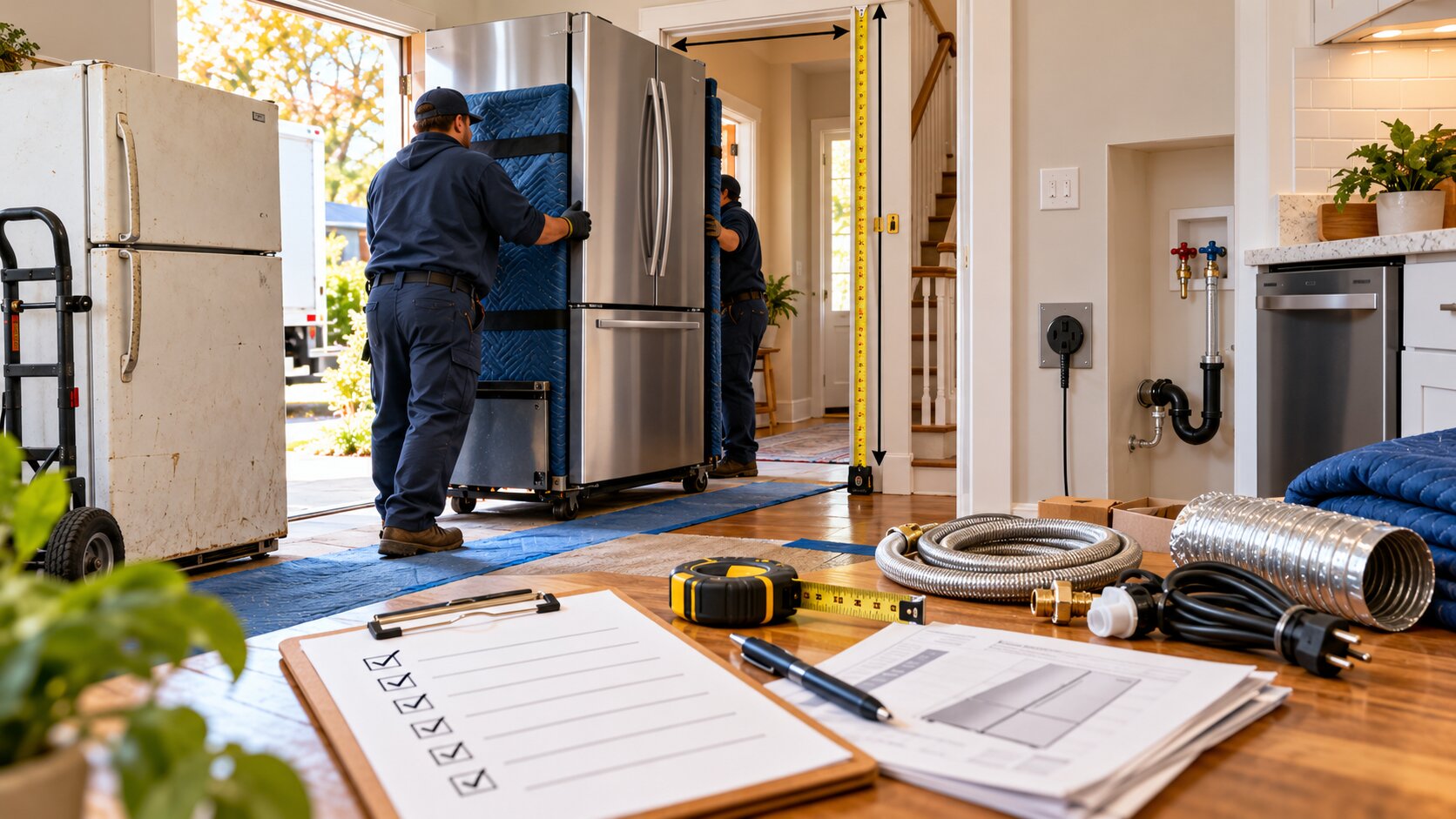
What to check at a glance
- Best for: Consumers buying a refrigerator, washer, dryer, dishwasher, range or similar major appliance.
- What this covers: Measurements, delivery access, installation, hookups, haul-away, damage inspection and warranty records.
- What this does not cover: DIY electrical, gas or complex plumbing installation.
- Main caution: Fitting the final opening does not guarantee the appliance can reach the room or connect safely.
- When to get professional help: Use an appropriately qualified contractor when the existing electrical, gas, plumbing or venting setup is unsuitable.
Confirm the appliance dimensions
Start with the manufacturer's specifications for the exact model you ordered.
Check:
- width;
- height;
- cabinet depth;
- depth with doors and handles;
- side, rear and top clearances;
- door-opening space.
Do not rely only on a retailer's size category.
Two appliances described as the same nominal width can have different hinges, handles, ventilation requirements and door clearances.
Keep the installation instructions
The manufacturer's installation manual should be your main reference for:
- electrical requirements;
- water connections;
- drainage;
- ventilation;
- anti-tip devices;
- placement clearances.
Review it before delivery rather than after the appliance is already in the room.
Measure the delivery path
Measure the entire route from the building entrance to the final appliance location.
Check:
- exterior entrance;
- vestibule;
- elevator;
- stairwell;
- hallways;
- interior doors;
- corners;
- final opening.
Think about height and turning space as well as width.
A refrigerator may fit through a doorway but still be unable to turn around the next corner.
Ask about removable appliance doors
Some refrigerator doors or handles can be removed during delivery.
Do not assume the delivery crew will remove building doors, railings or trim. If structural changes appear necessary, clarify responsibility and building permission before delivery day.
Check building delivery rules
Condominiums and apartment buildings may require:
- elevator booking;
- loading-dock reservation;
- specific delivery hours;
- elevator padding;
- advance notice;
- proof of insurance from the delivery company.
These conditions are building-specific.
Confirm the elevator dimensions and booking period before accepting the retailer's delivery window.
Separate delivery from installation
The word delivery can mean different things.
Possible service levels include:
- curbside;
- threshold;
- inside entry;
- room-of-choice;
- full installation.
Ask one practical question:
Where exactly will the appliance be when the delivery service is finished?
Then ask separately what installation includes.
Possible installation tasks may include:
- levelling;
- attaching hoses;
- connecting an existing drain;
- connecting an existing water supply;
- attaching a dryer vent;
- installing an anti-tip bracket;
- basic operational testing.
Do not assume installation includes modifying your home's wiring, gas piping, plumbing or cabinetry.
Check required parts and extra costs
The appliance price may not include everything needed to use it.
Possible extras include:
- washer hoses;
- dryer cord;
- dryer duct;
- dishwasher installation kit;
- refrigerator water line;
- range cord;
- stacking kit.
Use a total-cost table:
| Item | Included? | Cost |
|---|---|---|
| Delivery | ___ | C$___ |
| Installation | ___ | C$___ |
| Connection kit | ___ | C$___ |
| Cord or hose | ___ | C$___ |
| Old-appliance removal | ___ | C$___ |
| Stairs or long carry | ___ | C$___ |
| Total setup cost | C$___ |
Do not assume old cords or hoses should automatically be reused. Follow the manufacturer's installation requirements.
Confirm the electrical setup
Major appliances can require different electrical supplies.
Check the manufacturer's requirements for:
- voltage;
- plug configuration;
- outlet location;
- dedicated circuit;
- hard-wired installation.
Do not alter a plug, remove a grounding prong or improvise an adapter simply to make an appliance fit an incompatible outlet.
Health Canada advises against removing grounding prongs or using three-prong-to-two-prong adapters as a substitute.
Electrical upgrades are separate work
Electrical installation rules are provincial or territorial.
For example, Ontario's Electrical Safety Authority recommends using a Licensed Electrical Contracting Business for electrical upgrades and notes that regulated electrical work can require notification or inspection.
That is an Ontario example, not a Canada-wide licensing rule.
If the existing electrical supply does not match the appliance specifications, arrange appropriate electrical work before delivery.
Inspect plumbing before delivery
Washers, dishwashers and refrigerators with water features depend on usable existing connections.
Locate:
- shutoff valves;
- water lines;
- washer drain;
- dishwasher drain;
- refrigerator water connection.
Look for obvious:
- leaks;
- corrosion;
- damaged hoses;
- inaccessible or seized shutoff valves.
An appliance installer may be able to connect to a normal existing supply, but that does not mean the installer will repair failed plumbing or relocate pipes.
Health Canada also recommends checking washing-machine hoses and connections for leaks as part of household moisture control.
Treat gas appliances separately
Gas ranges and dryers require additional safety considerations.
Before ordering installation, confirm:
- whether the delivery company performs gas work;
- whether an appropriately qualified person will do it;
- whether local permits or inspections apply;
- whether the existing gas shutoff and connection are suitable.
Do not attempt to improvise a gas connection.
Gas-installation requirements vary by province and territory. For example, Technical Safety BC regulates gas-appliance work through applicable permitting, contractor and gas-fitter requirements.
Verify the requirements where you live.
Check dryer venting
A vented clothes dryer needs a suitable exhaust path.
Health Canada recommends venting clothes dryers outdoors and keeping dryer exhaust systems clear of lint and obstruction.
Before installation, check for:
- an exterior vent;
- damaged or crushed duct;
- lint buildup;
- obvious blockage;
- incompatible ducting.
The manufacturer's manual may specify:
- duct material;
- diameter;
- maximum route length;
- number of bends.
Do not assume the old vent arrangement automatically meets the new dryer's requirements.
Prepare refrigerator water connections
A refrigerator with an ice maker or water dispenser may require:
- existing water supply;
- accessible shutoff;
- suitable water line;
- correct fitting.
Ask whether the installation service includes the water connection and whether a new line is required.
Also check door swing.
A refrigerator can fit the opening yet still have a door that hits:
- a wall;
- cabinet;
- island;
- nearby appliance.
Review the manufacturer's clearance diagram.
Plan old-appliance removal
If haul-away is offered, clarify the conditions.
Ask:
- Is removal included?
- Must the old appliance be disconnected?
- Must refrigerators and freezers be empty?
- Must a freezer be defrosted?
- Will built-in appliances be removed?
- Is gas disconnection included?
- Are stairs extra?
Do not assume a delivery automatically includes removal of the old appliance.
Protect the delivery route
Before the crew arrives, clear:
- rugs;
- shoes;
- furniture;
- fragile items;
- pet equipment;
- other obstacles.
Keep children and pets away from the working area.
For vulnerable flooring, ask what protection the delivery company provides and what you should prepare.
Photographs of the route before delivery can also document existing wall, trim and floor condition.
Inspect the appliance on arrival
Before the delivery team leaves, check the appliance where practical.
Verify:
- model number;
- finish or colour;
- obvious dents;
- cracked panels;
- damaged doors;
- broken handles;
- missing accessories.
If damage is visible:
- photograph it;
- document it with the delivery team;
- contact the retailer promptly;
- keep the delivery paperwork.
Read anything you sign before confirming that the product was received in acceptable condition.
Know the damage and return process
Before buying, save the retailer's rules for:
- visible delivery damage;
- concealed damage;
- defective products;
- exchanges;
- change-of-mind returns;
- pickup fees;
- restocking charges.
The federal Office of Consumer Affairs notes that Canadian businesses generally do not have to accept returns simply because a customer changed their mind. Provincial or territorial protections may apply when goods are defective or otherwise fail legal requirements.
Rules can differ by province
Quebec's Office de la protection du consommateur, for example, provides specific guidance for damaged appliance deliveries and available merchant remedies.
That is Quebec-specific guidance, not a rule to apply identically throughout Canada.
Report shipping damage or an incorrect model promptly rather than waiting until a manufacturer's warranty claim becomes necessary.
Keep warranty information
Save:
- purchase receipt;
- delivery receipt;
- installation invoice;
- model number;
- serial number;
- manufacturer warranty.
Photograph the model and serial plate if it will become difficult to access later.
These records can help with:
- warranty service;
- repairs;
- parts lookup;
- recalls;
- insurance records.
Separate warranties from return policies
Three different protections may be relevant:
- retailer return or exchange policy;
- manufacturer warranty;
- provincial or territorial consumer-law rights.
They are not interchangeable.
The federal Office of Consumer Affairs notes that appliance warranty terms can vary and commonly distinguish manufacturing defects from problems caused by improper installation or misuse.
Read the actual warranty that accompanies your appliance.
Build your delivery-day checklist
| Check | Ready? |
|---|---|
| Exact model confirmed | ___ |
| Manufacturer dimensions checked | ___ |
| Required clearances checked | ___ |
| Delivery route measured | ___ |
| Elevator booked if required | ___ |
| Electrical supply ready | ___ |
| Plumbing ready | ___ |
| Gas professional arranged if needed | ___ |
| Dryer vent checked | ___ |
| Connection parts confirmed | ___ |
| Delivery scope confirmed | ___ |
| Installation scope confirmed | ___ |
| Old-appliance removal confirmed | ___ |
| Damage policy saved | ___ |
| Warranty saved | ___ |
Before the appliance truck arrives
Run through this checklist:
- Did I verify the exact model?
- Did I check manufacturer dimensions and clearances?
- Will it fit through every doorway, hallway, stairwell and corner?
- Is an elevator reservation required?
- Where does the delivery service stop?
- What installation work is included?
- Which cords, hoses or kits cost extra?
- Does the electrical supply match the appliance?
- Are plumbing connections accessible and usable?
- Does gas work require a qualified professional?
- Is dryer venting suitable?
- Is old-appliance removal included?
- Have I cleared and protected the route?
- Do I know what to do if the appliance arrives damaged?
- Have I saved the return and warranty terms?
Buying a major appliance is partly a product decision and partly a logistics decision.
Measure the complete route, verify the home's connections and confirm exactly what delivery and installation include before the truck arrives.
A little preparation can prevent another appointment, another contractor visit and another unexpected bill.
Frequently asked questions
What should I measure before appliance delivery?
Measure the final opening and the entire route, including entrances, hallways, stairwells, elevators, interior doors and tight corners. Also check manufacturer clearance requirements.
Does appliance delivery include installation?
Not necessarily. Delivery and installation can be separate services. Confirm where the crew will place the appliance and which connection tasks are included.
Can I reuse old washer hoses or dryer cords?
Do not assume so. The manufacturer or installer may require specific or new connection components.
Should I change an electrical outlet myself if the plug does not fit?
Do not modify the appliance plug or improvise an adapter. Arrange appropriate electrical work when the home's supply does not match the manufacturer's requirements.
Who should connect a gas range or dryer?
Gas-installation requirements are regulated provincially or territorially. Confirm that an appropriately qualified person will perform the work under the rules where you live.
Should a clothes dryer vent outside?
Health Canada recommends venting dryers outdoors and keeping the lint screen and exhaust system clear. Follow the exact appliance installation instructions.
What should I do if an appliance arrives damaged?
Photograph visible damage, document it with the delivery team and contact the retailer promptly under its damage-reporting process.
Can I return an appliance because I changed my mind?
Not automatically. Canadian businesses generally do not have to accept change-of-mind returns unless their policy or applicable provincial or territorial law provides that right.
Is a manufacturer warranty the same as a retailer return policy?
No. Manufacturer warranties, retailer return policies and statutory consumer protections are separate.
By: Yocahu Canada
Last updated: 2026-10-15
Disclosure: This article provides independent consumer information. No affiliate or sponsored relationship is identified for this article.
Important scope note
This article provides general consumer and household-safety information, not individualized electrical, plumbing, gas or legal advice. Installation rules, permits and consumer remedies vary by province or territory. Follow the appliance manufacturer's instructions and local requirements.
References
- Health Canada: Electrical product safety, federal guidance on appliance electrical safety, grounding and dryer lint/fire risks.
- Health Canada: Addressing moisture and mould in your home, guidance on washer connections, leaks and dryer exhaust maintenance.
- Office of Consumer Affairs: Refund and exchange, federal consumer guidance on change-of-mind returns.
- Office of Consumer Affairs: Warranties, federal guidance on household-appliance warranties and installation considerations.
- Office de la protection du consommateur du Québec: Appliance delivery problems, Quebec-specific guidance concerning delayed or damaged appliance deliveries.
Post a Comment