
Predictable is not permanent
A fixed expense is not necessarily a bill that will stay at the same price forever. It is usually an expense that is reasonably predictable during the budgeting period. Variable expenses move around more from month to month, while irregular expenses may appear only a few times a year.
That distinction matters because a budget built only around predictable monthly bills can look comfortable until an insurance renewal, car repair, seasonal utility bill or annual fee arrives. A more useful household budget gives all three types of expenses a place before the money is spent.
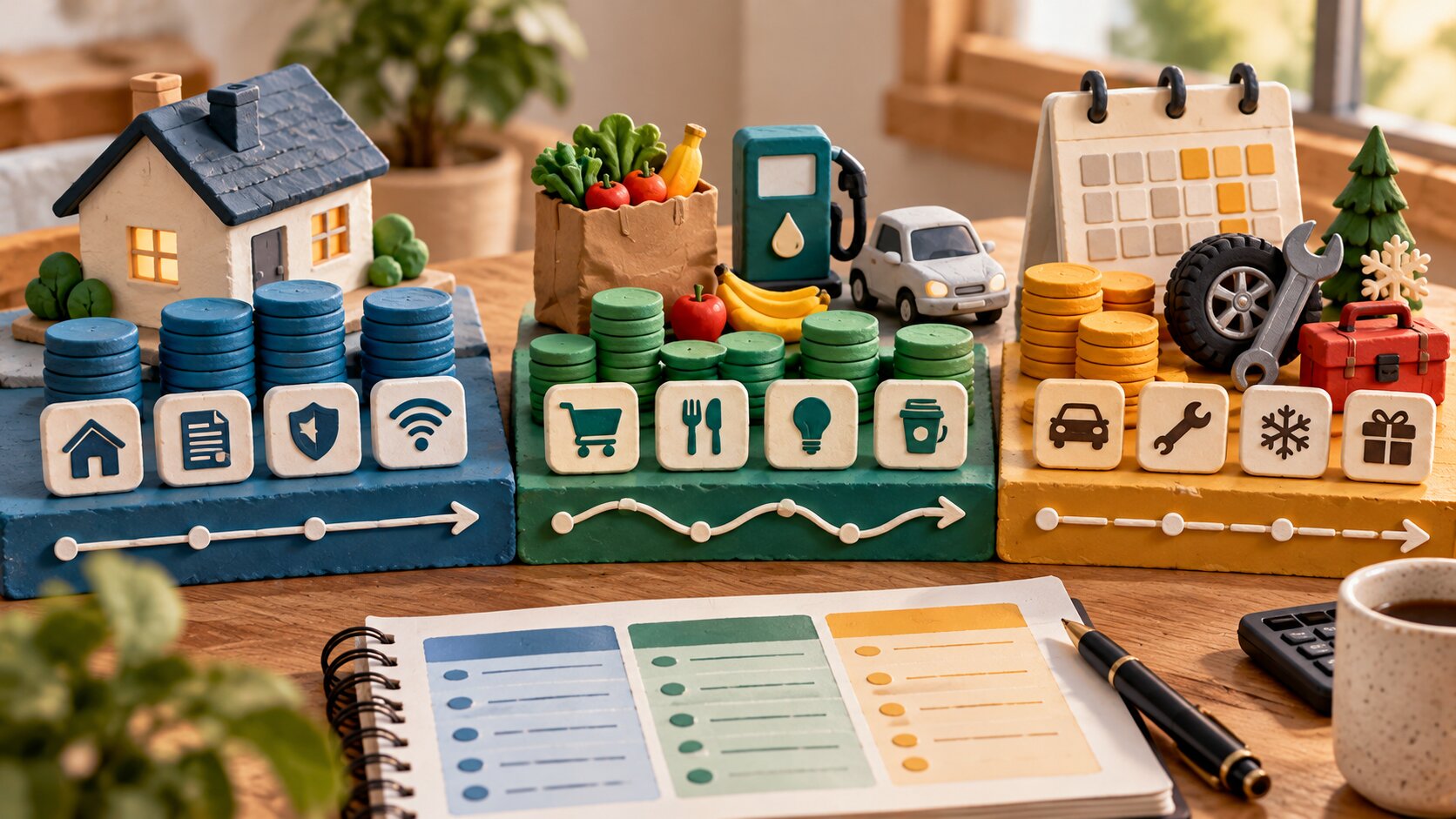
The three expense types at a glance
- Best for: Households trying to understand where their money goes and make monthly costs easier to anticipate.
- What this covers: Fixed, variable and irregular expenses, monthly averaging, spending ranges, recurring-cost reviews and household budgeting.
- What this does not cover: Personalized investment advice, debt-repayment recommendations or a prescribed spending ratio.
- Main caution: An expense can be predictable today and change after a renewal, price increase, promotion expiry or household change.
- When to get professional help: Consider qualified financial or credit-counselling help if you cannot meet essential bills, are relying on new debt for routine expenses, or need individualized advice about a difficult financial situation.
What counts as a fixed expense
The Financial Consumer Agency of Canada describes fixed expenses as costs that come up every month and are roughly the same amount each month.
Common household examples can include:
- rent;
- mortgage payments;
- certain loan payments;
- insurance premiums paid monthly;
- childcare with a regular monthly fee;
- internet or mobile plans with predictable billing;
- subscriptions;
- parking with a set monthly charge.
The useful word is roughly.
A fixed expense does not have to be mathematically identical every month, and it is not guaranteed to stay at the same price indefinitely.
Fixed for the budget period
Suppose your internet plan costs C$75 per month during the period you are budgeting.
For practical purposes, C$75 can sit in the fixed-expense section.
If a promotional discount expires in three months and the monthly charge changes, update the budget at that point. The service did not suddenly stop being a recurring commitment. Its expected amount simply changed.
The same idea can apply to:
- an insurance renewal;
- a rent increase where permitted;
- a mortgage renewal;
- a subscription price change;
- the end of a vehicle loan.
Treat "fixed" as predictable enough to plan, not "permanently frozen."
What counts as a variable expense
Variable expenses change more noticeably from month to month.
FCAC examples include categories such as groceries, transportation, clothing, eating out and entertainment.
Other household examples may include:
- electricity where usage affects the bill;
- natural gas;
- fuel;
- household supplies;
- personal care;
- pet expenses;
- discretionary shopping;
- recreation.
Some variable expenses are necessities.
Groceries can vary even though eating is obviously not optional. Fuel can vary even when driving to work is necessary.
That is why "variable" should not be confused with "unnecessary."
Ask why the amount changes
A useful variable-expense budget looks at the reason for the variation.
For example, electricity may change because of:
- season;
- heating or cooling;
- time spent at home;
- rate structure;
- household size.
Groceries may change because of:
- number of people at home;
- hosting;
- food prices;
- shopping frequency;
- dietary needs;
- household waste.
Understanding the driver of the change helps you build a realistic range rather than simply guessing one monthly number.
Do not forget irregular expenses
This is the category that can make an otherwise careful budget fail.
FCAC budgeting guidance separately identifies irregular or periodic expenses that do not occur every month. Its examples include travel, tuition, gifts and car repairs.
For a typical household, other irregular expenses may include:
- annual insurance premiums;
- vehicle registration or licence renewals;
- seasonal tire changes;
- vehicle maintenance;
- home repairs;
- appliance replacement;
- school expenses;
- memberships paid annually;
- holiday spending;
- professional fees;
- seasonal clothing;
- vet bills;
- property tax where it is not incorporated into another payment.
These costs can feel unexpected when they hit the bank account even when the household knew they would eventually happen.
Irregular is not the same as unforeseeable
Replacing a failed appliance may be difficult to predict.
An annual membership renewal in November is different. You already know when it is coming.
A useful budget treats known annual and seasonal expenses as future bills rather than surprises.
Build three budget buckets
A simple system is often more useful than dozens of accounting categories.
| Budget bucket | Typical examples | Practical method |
|---|---|---|
| Fixed | Rent, loan payment, subscription | Enter expected monthly amount |
| Variable | Groceries, fuel, utilities | Use recent spending and a realistic range |
| Irregular | Repairs, annual renewals, seasonal costs | Set aside money over time |
You can create detailed subcategories underneath these three buckets later.
The first goal is to stop different types of expenses from being treated as if they behave the same way.
Start from actual records
FCAC recommends using recent pay stubs, bills and account statements when building a budget.
That is more useful than creating a budget from memory.
Review several months of:
- bank statements;
- credit-card statements;
- utility bills;
- receipts;
- subscription charges.
Look for anything that repeats.
Small charges are easy to miss individually but can become meaningful once several recurring services are added together.
Turn annual expenses into monthly amounts
Known annual expenses can be converted into a monthly planning amount.
The calculation is simple:
Expected annual cost ÷ 12 = monthly amount to set aside
If an annual cost is C$1,200, dividing it across 12 months gives a planning amount of C$100 per month.
That does not mean C$100 will actually be charged each month. It means your budget acknowledges the expense throughout the year instead of absorbing all C$1,200 in one month.
Use the same approach for other cycles
You can adapt the method.
A C$600 expense expected six months from now could be treated as C$100 per month for the next six months.
A known C$300 expense expected in three months could be treated as C$100 per month until it is due.
These examples are mathematical illustrations, not recommended spending amounts.
The useful question is:
How much would I need to set aside regularly so this known expense does not become a crisis when it arrives?
Use ranges for expenses that fluctuate
A variable expense does not need a fake level of precision.
Instead of saying groceries will be exactly C$700 every month, try recording:
- low month;
- normal month;
- high month.
For example:
| Expense | Low month | Normal month | High month |
|---|---|---|---|
| Groceries | C$___ | C$___ | C$___ |
| Electricity | C$___ | C$___ | C$___ |
| Fuel/transit | C$___ | C$___ | C$___ |
| Household supplies | C$___ | C$___ | C$___ |
Fill these figures using your own actual spending.
This approach makes the budget more resilient when an expense naturally moves around.
Budget from reality, not the best month
If your grocery spending over four recent months was C$580, C$620, C$690 and C$650, using the lowest month as the permanent budget can create a recurring shortfall.
A normal range or average is usually more informative than selecting the most optimistic figure.
FCAC advises comparing your budget with your actual spending and adjusting budget figures when actual costs repeatedly differ.
That is an important principle: a budget should change when reality proves it wrong.
Separate commitments, needs and choices
Fixed versus variable describes how an expense behaves.
It does not tell you how easy it is to change.
Add a second classification:
Commitments
These may be difficult, expensive or slow to change.
Examples:
- housing payment;
- vehicle loan;
- contracted service;
- childcare arrangement.
Needs
Necessary household spending that may still fluctuate.
Examples:
- food;
- basic utilities;
- transportation to work;
- medication or essential health-related purchases;
- basic household supplies.
Choices
Spending that may be easier to reduce, delay or remove.
Examples could include:
- some entertainment;
- dining out;
- optional subscriptions;
- non-essential upgrades.
The category depends on the household.
A vehicle may be optional for someone living beside frequent public transit and essential for someone whose work cannot be reached without one.
FCAC similarly notes that needs and wants vary according to an individual's circumstances.
Watch for expenses that change category
Household expenses are not static.
A cost that was fixed can disappear, rise or become less predictable.
Promotion expires
An internet bill might be predictable at C$65 during a promotional period, then become C$90 afterward.
The budget needs a review date before the price change.
Loan ends
A vehicle loan may disappear from the monthly commitments once it is paid off.
That does not mean the vehicle becomes cost-free. Maintenance and repair costs can become more important as the vehicle ages.
Insurance renews
The monthly premium may change at renewal.
Update the budget when the new premium is confirmed.
Household changes
Moving, changing jobs, adding childcare, working remotely or changing commuting patterns can affect several categories at once.
A budget that was accurate six months ago can become outdated without any obvious single mistake.
Build a monthly household-cost dashboard
A simple dashboard can show not only what you spend but how predictable each expense is.
| Expense | Type | Normal amount | High-month amount | Next review |
|---|---|---|---|---|
| Housing | Fixed | C$_____ | C$_____ | _____ |
| Internet | Fixed | C$_____ | C$_____ | _____ |
| Insurance | Fixed/periodic | C$_____ | C$_____ | _____ |
| Electricity | Variable | C$_____ | C$_____ | _____ |
| Groceries | Variable | C$_____ | C$_____ | _____ |
| Transportation | Variable | C$_____ | C$_____ | _____ |
| Vehicle maintenance | Irregular | C$_____ saved | C$_____ | _____ |
| Home repairs | Irregular | C$_____ saved | C$_____ | _____ |
| Annual memberships | Irregular | C$_____ saved | C$_____ | _____ |
The next review column is particularly useful for costs that can change at a known time.
Examples:
- insurance renewal;
- internet promotion ending;
- subscription anniversary;
- mortgage renewal;
- lease renewal.
A predictable change should not have to become an unexpected bill.
Review the budget against what you actually spend
Creating a budget once is not enough.
FCAC recommends comparing planned spending with actual spending at the end of each month and adjusting when the differences are persistent.
Ask:
- Which categories were higher than planned?
- Which were lower?
- Was the difference unusual or normal?
- Did I forget an irregular expense?
- Did a price or household circumstance change?
Look for patterns, not one unusual month
One unusually high heating bill does not necessarily mean the annual budget is broken.
Three or four consistently higher months may mean your estimate needs updating.
Similarly, a one-time low grocery month should not automatically become the new target.
Use several months of information when possible.
Add review dates to recurring services
Some bills deserve active review rather than passive renewal.
Possible review points include:
- internet promotion expiry;
- mobile contract changes;
- insurance renewal;
- subscription anniversary;
- parking renewal;
- storage rental;
- annual membership.
The question is not always "Can I cancel this?"
It may be:
- Do I still use it?
- Has the price changed?
- Is there a lower-cost option that still meets the need?
- Has my household changed enough that the service no longer fits?
Create room for unexpected expenses
Not every irregular expense can be predicted.
A vehicle can break down earlier than expected. A home repair may become urgent. A household appliance may fail.
FCAC budgeting materials recommend making room for unexpected costs and savings.
The goal is not to predict the exact date or amount of every future problem.
It is to avoid constructing a budget in which every dollar is already committed before anything unexpected occurs.
Keep predictable and unexpected costs separate
Consider two different concepts:
Known future expenses
You know the bill is coming, even if it is months away.
Unexpected expenses
You do not know exactly what will happen or when.
An annual licence renewal belongs in the first category.
An unplanned repair belongs in the second.
Treating both as "emergencies" can hide costs that were actually foreseeable.
Before you call the budget finished
Run through this checklist:
- Have I listed my fixed monthly commitments?
- Which expenses actually change from month to month?
- Have I reviewed several months of real transactions?
- Which annual, seasonal or irregular expenses are missing?
- Am I setting aside money for known future expenses?
- Have I allowed room for unexpected costs?
- Which bills have promotions or renewal dates?
- Have any subscriptions or services stopped being useful?
- Does the budget reflect a normal month rather than my cheapest month?
- Are important necessities being mistaken for discretionary expenses simply because their cost varies?
- Have I compared the budget with what I actually spend?
- When will I review it again?
A useful household budget is not a prediction that every month will behave perfectly.
It is a map of what is predictable, what can move and what is likely to arrive later. When fixed, variable and irregular expenses each have a place, changes are easier to spot and ordinary annual costs are less likely to feel like emergencies.
Frequently asked questions
What is the difference between fixed and variable expenses?
Fixed expenses are generally predictable and roughly the same each month. Variable expenses change more from month to month. FCAC examples of fixed costs include housing and insurance, while variable categories can include groceries, transportation, clothing and entertainment.
Are utilities fixed or variable expenses?
It depends on how the bill works. A utility charge that changes according to consumption is usually more useful to treat as variable. Some budgeting materials group relatively predictable utility costs with fixed expenses. The practical goal is to classify the bill according to how predictable it is for your household.
What are irregular expenses?
Irregular or periodic expenses are costs that do not occur every month. Examples can include car repairs, travel, gifts, annual fees and seasonal expenses. Known irregular expenses can often be divided into smaller amounts and planned for over several months.
Is rent always a fixed expense?
Rent is generally treated as fixed during a budgeting period because the required payment is predictable. It can still change after a lawful rent adjustment, new agreement or move, so update the budget when the expected amount changes.
How should I budget for an annual bill?
One practical method is to divide the expected bill by the number of months available before it is due and set aside that amount regularly. For a C$1,200 annual expense spread across 12 months, the illustrative monthly amount would be C$100.
How often should I review my household budget?
FCAC recommends comparing your budget with actual spending each month and adjusting figures when necessary. It is also useful to review costs when a promotion ends, a contract renews, income changes or household circumstances change.
By: Yocahu Canada
Last updated: 2026-10-15
Disclosure: This article provides independent consumer information. No affiliate or sponsored relationship is identified for this article.
Important scope note
This article provides general consumer budgeting information, not individualized financial, investment, credit or debt advice. Household priorities and necessary expenses differ. Use your own current bills, statements and circumstances when building a budget.
References
- Financial Consumer Agency of Canada: Making a budget, current guidance on creating a budget, reviewing actual spending, needs and wants, and keeping a budget up to date.
- Financial Consumer Agency of Canada: How do I prepare a budget?, guidance on fixed, variable and irregular expenses and planning for periodic costs.
Post a Comment