
Winter starts before snow
Winter-tire decisions are not only about whether snow is falling today. Cold temperatures change how tires behave, and icy, slushy or snow-covered roads create demands that ordinary dry-road driving does not.
Transport Canada says all-season and summer tires begin losing elasticity below about 7°C, while winter tires are designed to stay more flexible at lower temperatures. That does not mean every driver faces the same conditions or legal requirements. Your climate, routes, driving schedule, tire condition and province all matter when deciding when to install, replace or continue using winter tires.
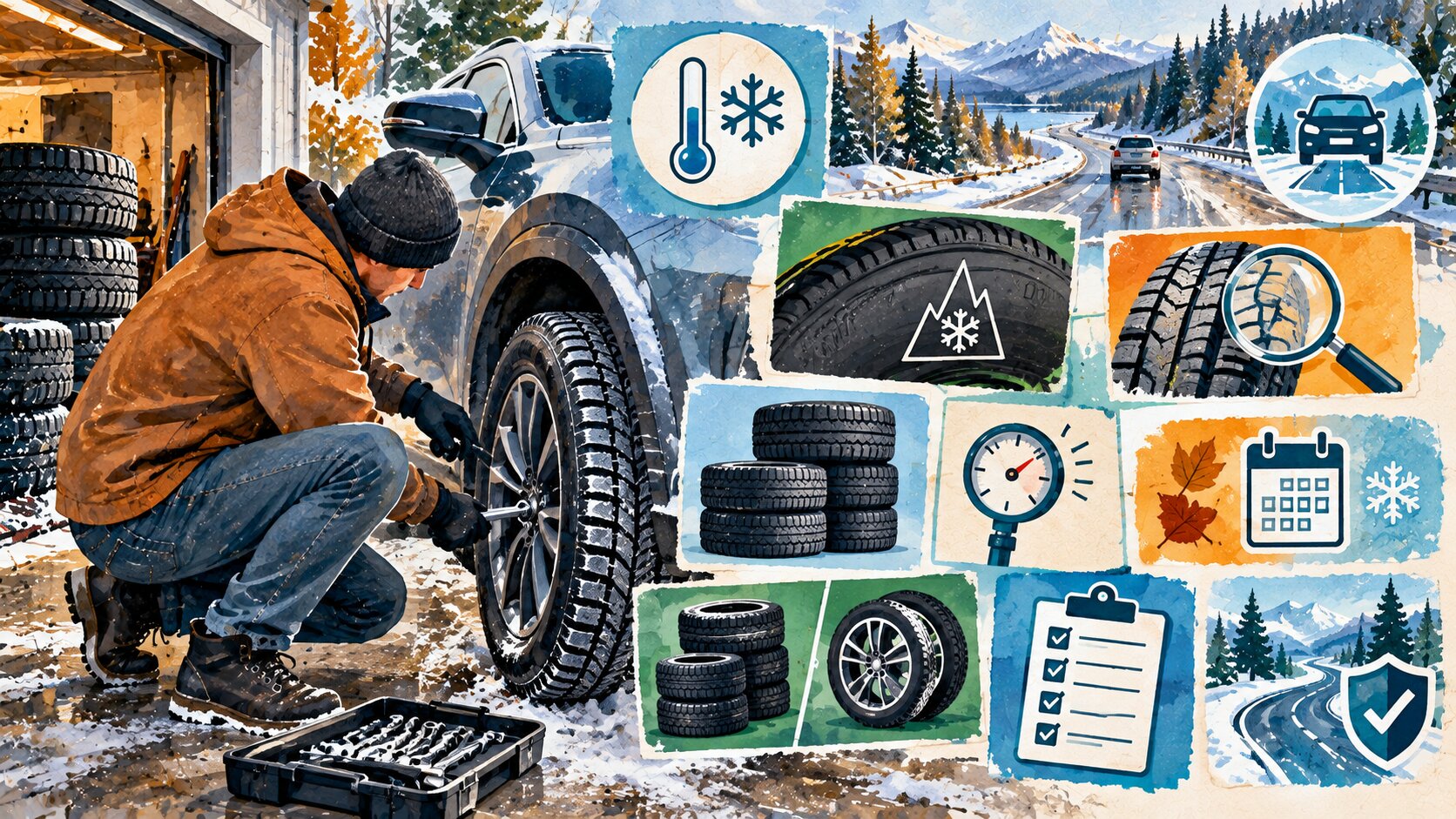
What to check at a glance
- Best for: Drivers deciding whether they need winter tires, whether their current set is still suitable, or when to install them.
- What this covers: Temperature, winter-tire markings, tread condition, pressure, four-tire matching, legal requirements and seasonal costs.
- What this does not cover: A recommendation for a specific tire brand, size or model.
- Main caution: Winter tires improve traction, but they cannot overcome excessive speed, poor visibility or severe road conditions.
- When to get professional help: Ask a qualified tire professional when you are unsure about tire size, damage, uneven wear, repairs, compatibility or whether a particular tire is suitable for your vehicle.
Start with where and how you drive
The need for winter tires is easier to judge when you look at actual driving conditions instead of only the calendar.
Consider:
- how often temperatures stay near or below freezing;
- how much snow, slush or ice your area receives;
- whether you drive before roads are cleared;
- how much highway driving you do;
- whether your routes include steep grades;
- whether you travel through mountain passes;
- whether you regularly drive early in the morning or late at night;
- whether you can stay home during poor weather.
Someone who can avoid driving during storms may face a different level of exposure from someone who must commute every day regardless of weather.
Think about the route, not just the city
Conditions can change dramatically over one trip.
A mostly urban driver may still encounter:
- rural highways;
- exposed bridges;
- shaded roads;
- mountain routes;
- higher elevations.
If a significant part of your driving regularly takes you into colder or snowier areas, make the tire decision around the most demanding normal part of your route, not only the conditions outside your home.
Understand winter, all-season and all-weather tires
These terms are easy to blur together.
Winter tires
Winter tires are designed specifically for cold and severe snow conditions.
Transport Canada advises consumers to look for the three-peak mountain and snowflake symbol when shopping for winter tires.
All-season tires
All-season tires are designed for a broad range of conditions but are not necessarily optimized for severe winter use.
Transport Canada notes that all-season and summer compounds begin losing elasticity below about 7°C, reducing traction compared with tires designed for winter conditions.
All-weather tires
Some all-weather tires carry the three-peak mountain and snowflake symbol and are designed to meet winter-traction requirements while also being used year-round.
That does not mean every all-weather tire performs identically to every dedicated winter tire.
The important step is checking the tire's certification, condition and suitability for your driving rather than relying only on the marketing category.
Look for the mountain-and-snowflake symbol
The three-peak mountain and snowflake symbol is an important winter-tire identifier.
Transport Canada says tires marked with this symbol meet specific snow-traction performance requirements and are designed for severe snow conditions.
This is different from relying only on an M+S, or Mud and Snow, marking.
The distinction matters by jurisdiction
For general winter performance, Transport Canada recommends the mountain-and-snowflake symbol.
Provincial legal definitions can differ.
British Columbia, for example, recognizes qualifying winter tires on designated routes if they carry either the mountain-and-snowflake symbol or the M+S marking and meet the province's minimum tread requirement.
Quebec has stricter winter-tire requirements for Quebec-registered vehicles during its mandatory period, and compliant tires generally require the recognized winter pictogram or another permitted form such as approved studded tires.
That is why a tire can satisfy one jurisdiction's legal minimum without necessarily representing the strongest winter-performance choice for your driving.
Decide when to install winter tires
Do not wait for the first major snowfall if your normal temperatures are already consistently cold.
Transport Canada says all-season and summer tires begin losing elasticity below about 7°C.
That makes sustained colder weather a more useful installation signal than one specific national date.
There is no single installation date for Canada
Climate varies too much.
Early autumn can feel like winter in one region while another still has mild conditions.
Use:
- local temperature trends;
- expected travel;
- provincial requirements;
- installer availability.
Booking early can also reduce the chance of competing for an appointment after the first major storm.
Know the legal rules where you drive
There is no single nationwide winter-tire mandate for passenger vehicles.
Provincial requirements can differ significantly.
Quebec
For most motor vehicles registered in Quebec, winter tires are mandatory from December 1 through March 15, subject to listed exemptions.
Quebec requires four compliant winter tires during that period.
The Quebec government also recommends installing them before the legal deadline when local winter conditions arrive earlier.
British Columbia
British Columbia does not impose the same province-wide passenger-vehicle mandate as Quebec.
Instead, winter tires or chains are required on designated routes during posted seasonal periods.
Depending on the highway, those periods can run from October 1 to March 31 or October 1 to April 30.
For qualifying winter tires under B.C. rules, the province recognizes the mountain-and-snowflake symbol or M+S marking, with at least 3.5 mm of tread depth.
Check before travelling
A driver who meets the rules at home can still enter a route with different requirements.
Before winter travel:
- check destination rules;
- check highway signage;
- check seasonal route requirements;
- confirm tire condition.
Do not assume a rule from one province applies nationwide.
Inspect tread and physical condition
A tire can carry the correct winter symbol and still be too worn to perform well.
Transport Canada advises against using winter tires worn close to 4 mm of tread depth on snow-covered roads.
That recommendation is more conservative than some minimum legal tread limits.
Check more than depth
Inspect all four tires for:
- uneven wear;
- cracking;
- cuts;
- bulges;
- exposed cords;
- damaged sidewalls;
- embedded objects;
- questionable repairs.
If you see physical damage, have the tire inspected rather than assuming tread depth alone makes it safe.
Quebec provides its own practical guidance
Quebec's road-safety authority recommends that used winter tires have at least 4.8 mm of tread depth when installed for the season to provide better winter traction.
That is guidance for winter performance, not a universal Canada-wide legal replacement threshold.
Use four compatible winter tires
Transport Canada recommends installing winter tires in sets of four.
Using only two winter tires can create an imbalance in traction between the front and rear axles.
For more predictable handling, Transport Canada recommends tires with compatible:
- type;
- size;
- speed rating;
- load index.
It also advises against mixing substantially different tread patterns, construction or sizes.
Put the better tires on the rear
Where tread depths differ, Transport Canada advises placing the tires with deeper tread on the rear axle to help maintain directional control.
Ideally, regular rotation keeps tread wear relatively even across the set.
Check tire pressure in cold weather
Tire pressure falls as temperature falls.
Transport Canada states that tire pressure can decrease by about 1 psi for every 5°C drop in temperature.
That means a tire adjusted during warmer weather may become underinflated once winter arrives.
Check pressure when the tires are cold
For an accurate reading, Transport Canada recommends checking tires when they are cold.
The recommended pressure is usually listed:
- on the driver's door or door frame;
- on the vehicle's tire-information label;
- in the owner's manual.
Do not use the maximum pressure moulded into the tire sidewall as your normal target.
Recheck after major temperature changes
Pressure is not a one-time seasonal task.
Check it:
- regularly;
- after a significant temperature drop;
- before longer highway trips;
- when the tire-pressure warning appears.
Also check the spare tire if the vehicle has one.
Compare separate winter wheels with seasonal remounting
A winter tire does not necessarily require a second set of wheels, but separate winter wheels can change the cost and convenience calculation.
One set of wheels
You can mount winter and summer or all-season tires on the same wheels.
Possible advantages:
- lower upfront wheel cost;
- no need to purchase a second wheel set.
Possible disadvantages:
- tires must be mounted and removed each season;
- repeated mounting involves additional service;
- scheduling may take longer.
Separate winter wheels
A dedicated set can allow the whole wheel-and-tire assembly to be swapped seasonally.
Possible advantages:
- faster seasonal changeovers;
- less repeated mounting of tire beads;
- potential convenience over several seasons.
Possible disadvantages:
- higher upfront cost;
- additional storage space;
- wheel compatibility must be correct;
- tire-pressure monitoring systems can add complexity on some vehicles.
There is no universal winner.
Compare the cost over the number of years you expect to keep the vehicle.
Budget beyond the tire purchase
The tire price is only one part of seasonal ownership.
Possible costs include:
- winter tires;
- separate wheels;
- mounting;
- balancing;
- seasonal installation;
- storage;
- tire-pressure monitoring service;
- replacement hardware;
- disposal when tires reach end of life.
Use a comparison table.
| Cost | Same wheels | Separate winter wheels |
|---|---|---|
| Winter tires | C$_____ | C$_____ |
| Wheels | C$0 | C$_____ |
| Initial mounting | C$_____ | C$_____ |
| Seasonal changeover | C$_____ | C$_____ |
| Storage | C$_____ | C$_____ |
| TPMS-related costs | C$_____ | C$_____ |
| Estimated multi-season cost | C$_____ | C$_____ |
Use actual quotes for your vehicle.
A setup that costs more initially can still be worthwhile if it lowers future service costs or makes seasonal changes easier for the years you own the vehicle.
Know when winter tires are not enough
Winter tires improve traction. They do not make winter roads behave like dry summer pavement.
Even with suitable tires:
- braking distances can increase;
- black ice can provide little warning;
- visibility can deteriorate quickly;
- snow can hide lane markings;
- high winds can affect control;
- road closures can still occur.
Adjust driving to the conditions.
Reduce speed when conditions worsen
The more limited the traction and visibility, the more important it becomes to:
- reduce speed;
- leave more following distance;
- make smoother steering inputs;
- brake earlier;
- avoid unnecessary trips in severe conditions.
A good tire increases the vehicle's available grip. It does not cancel the laws of physics.
Build your final winter-tire decision
Use your own driving conditions to weigh the decision.
| Factor | Your situation |
|---|---|
| Sustained cold-weather exposure | ___ |
| Snow and ice frequency | ___ |
| Highway driving | ___ |
| Mountain or rural routes | ___ |
| Ability to avoid storms | ___ |
| Current tire tread | ___ |
| Current tire condition | ___ |
| Local legal requirement | ___ |
| Seasonal storage available | ___ |
| Installation/storage budget | ___ |
| Overall need | ___ |
Strong reasons to act sooner
Winter tires deserve more weight when:
- temperatures regularly fall below about 7°C;
- you commute regardless of weather;
- roads frequently carry snow or ice;
- you travel mountain or rural routes;
- your jurisdiction requires qualifying winter tires;
- your current tires are worn or damaged.
Reasons the decision may be different
The decision may require more comparison when:
- winter is mild;
- driving is infrequent;
- you can avoid poor-weather travel;
- a properly certified all-weather tire already fits your situation;
- local law does not mandate a dedicated winter set.
The decision should still start with safety and legal requirements.
Before winter driving season
Run through this checklist:
- What temperatures and road conditions do I normally drive in?
- Does my province or route have a winter-tire requirement?
- Do my tires carry the appropriate winter marking?
- How much tread remains?
- Are there cracks, bulges, uneven wear or other damage?
- Are all four tires compatible?
- Is tire pressure set to the vehicle manufacturer's recommendation?
- Have I checked pressure after colder weather arrived?
- Do I need separate winter wheels or seasonal remounting?
- Have I included storage and seasonal service costs?
- Have I booked installation before the busiest part of the season?
- Will I still adjust my driving when roads become dangerous?
Winter tires are most useful when they are treated as one part of winter preparation rather than a guarantee of traction.
Choose tires for the conditions you actually drive in, keep them properly inflated and in good condition, and check the legal rules for every jurisdiction and route where winter travel is part of your normal life.
Frequently asked questions
At what temperature should I consider winter tires?
Transport Canada says all-season and summer tires begin losing elasticity below about 7°C, while winter tires retain grip at lower temperatures. Sustained temperatures around or below that point are a useful signal to prepare rather than waiting for the first snowfall.
What does the three-peak mountain and snowflake symbol mean?
Transport Canada says tires displaying the symbol meet specific snow-traction performance requirements and are designed for severe snow conditions.
Do I need four winter tires?
Transport Canada recommends winter tires on all four wheels to help maintain predictable control and stability.
How much tread should winter tires have?
Transport Canada advises against using tires worn close to 4 mm on snow-covered roads. Local legal minimums can differ. Quebec, for example, recommends at least 4.8 mm when installing used winter tires for the season, while B.C. requires at least 3.5 mm for qualifying winter tires under its designated-route rules.
When are winter tires mandatory in Quebec?
For most Quebec-registered motor vehicles covered by the rule, compliant winter tires are required from December 1 through March 15.
Are winter tires mandatory everywhere in British Columbia?
No. B.C. requires qualifying winter tires or chains on designated routes during posted periods. Depending on the route, requirements generally run from October 1 through March 31 or April 30.
Does cold weather lower tire pressure?
Yes. Transport Canada says tire pressure can drop by about 1 psi for every 5°C decrease in temperature. Check pressure when the tires are cold and use the vehicle manufacturer's recommended value.
By: Yocahu Canada
Last updated: 2026-10-15
Disclosure: This article provides independent consumer information. No affiliate or sponsored relationship is identified for this article.
Important scope note
This article provides general consumer and road-safety information, not individualized mechanical or legal advice. Tire requirements vary by province, route, vehicle and tire type. Check the current rules where you drive and follow the tire and vehicle manufacturers' specifications.
References
- Transport Canada: Using winter tires, federal guidance on winter-tire markings, cold-weather performance, tread, four-tire installation and pressure.
- Transport Canada: Inflating your tires, federal guidance on cold tire-pressure checks and temperature-related pressure changes.
- Gouvernement du Québec: Winter tire obligations, current Quebec winter-tire dates, scope and exceptions.
- SAAQ: Winter preparation, Quebec guidance on winter-tire markings, installation timing and tread condition.
- British Columbia Motor Vehicle Act Regulations: Winter tires, current B.C. legal definition, permitted markings and minimum tread depth.
Post a Comment