
Check before you pay
A used vehicle can look like a bargain because of its asking price, mileage or appearance, yet still be the wrong purchase once repairs, insurance, tires, fuel, history or ownership issues are considered.
The safest approach is to separate three questions: Does this type of vehicle fit your needs? Is this particular vehicle in acceptable condition? And can the ownership and sale be verified properly? This checklist helps you work through those questions before money changes hands. Registration, lien, inspection and dealer rules vary by province and territory, so local requirements should always be checked before completing a sale.
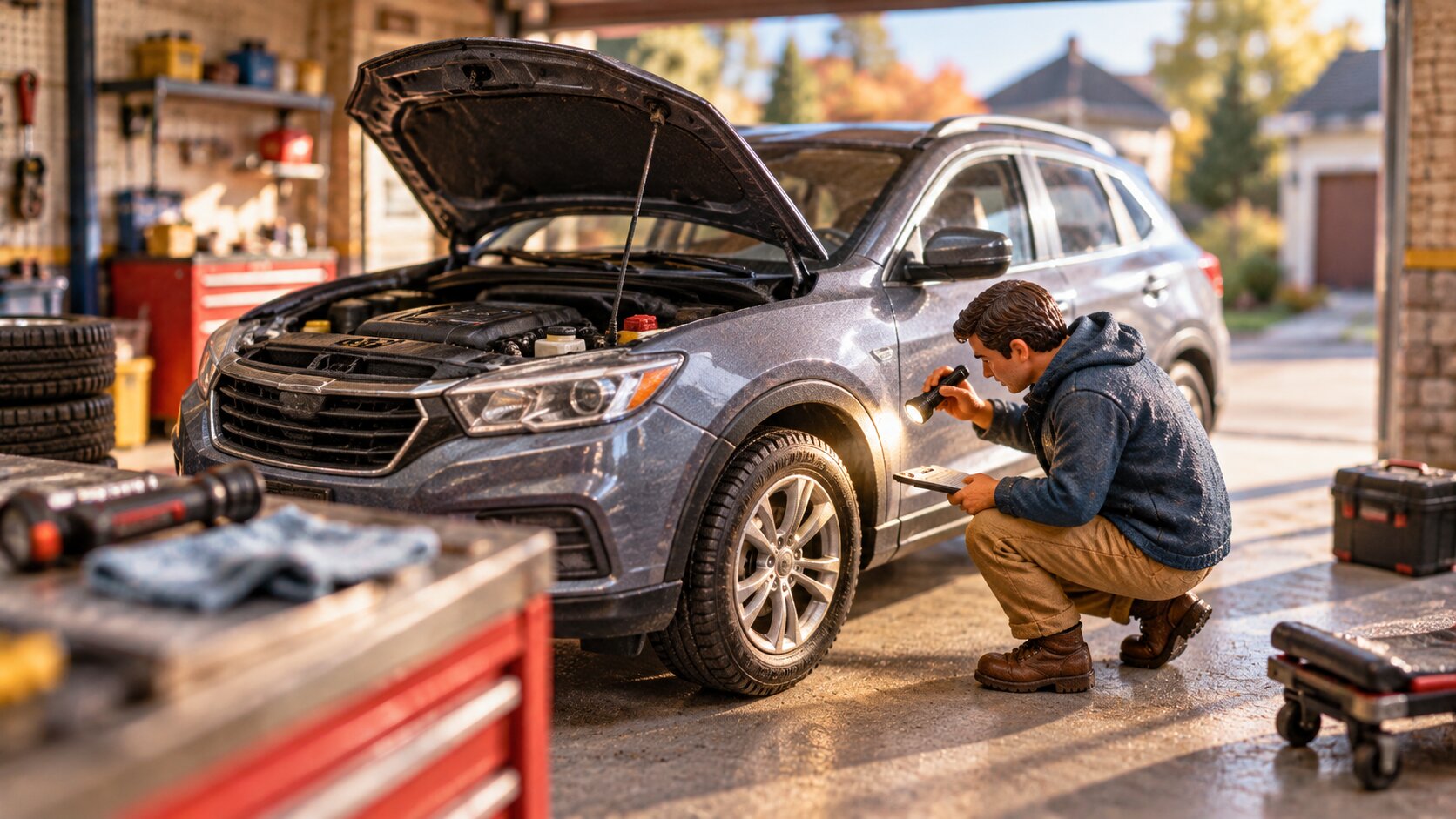
What to check at a glance
- Best for: Buyers comparing a used car, SUV, van, pickup or other personal vehicle.
- What this covers: Budget, condition, test driving, records, recalls, inspection, VIN checks, liens and purchase documentation.
- What this does not cover: A mechanical diagnosis or a complete explanation of every provincial or territorial registration rule.
- Main caution: A low purchase price can be offset quickly by repairs, tires, insurance, financing or unresolved ownership issues.
- When to get professional help: Use a qualified mechanic for condition questions and the appropriate provincial or territorial registration, consumer-protection or legal authority when ownership, liens, documentation or sale terms are unclear.
Decide what kind of vehicle you actually need
Before evaluating a particular car, decide what job the vehicle needs to do.
A vehicle that works well for a short urban commute may be a poor fit for frequent highway travel, a large family, towing or regular winter driving outside major urban areas. Starting with your needs also helps prevent an attractive price from becoming the only reason to buy.
Consider:
- how many kilometres you expect to drive each year;
- how many passengers you routinely carry;
- cargo space you genuinely use;
- city, highway or mixed driving;
- winter conditions where you live and travel;
- parking space and vehicle size;
- fuel or charging needs;
- towing or hauling requirements;
- accessibility needs;
- expected insurance cost.
It can help to identify two lists before shopping.
Must-haves are features or capabilities the vehicle needs to have.
Preferences are things you would like but could live without.
That distinction makes it easier to reject a tempting vehicle that does not actually fit your life.
Compare the first-year cost, not only the asking price
The purchase price is only one part of the decision.
A cheaper vehicle may need tires, brakes, fluids, scheduled maintenance or other work soon after purchase. A more expensive vehicle may have lower immediate repair needs but higher insurance or fuel costs.
Use the same categories when comparing vehicles.
| First-year cost | Vehicle A | Vehicle B |
|---|---|---|
| Purchase price | C$_____ | C$_____ |
| Taxes and registration | C$_____ | C$_____ |
| Immediate repairs | C$_____ | C$_____ |
| Tires | C$_____ | C$_____ |
| Insurance estimate | C$_____ | C$_____ |
| Fuel or charging estimate | C$_____ | C$_____ |
| Scheduled maintenance | C$_____ | C$_____ |
| Estimated first-year total | C$_____ | C$_____ |
Do not use a generic online estimate as a substitute for quotes that apply to the specific vehicle and your circumstances.
A simple comparison example
Suppose one vehicle is C$2,000 cheaper but needs a set of tires and several immediate repairs. Another costs more upfront but has recent maintenance records and fewer obvious near-term expenses.
The lower sticker price may still be the better purchase, but you cannot know that from the asking price alone.
The useful number is the cost of getting the vehicle into dependable everyday use.
Inspect the exterior before the test drive
Start looking before the engine is running.
Walk around the vehicle in good light if possible. You are not trying to perform a professional collision assessment. You are looking for signs that deserve a closer question or professional inspection.
Check:
- body panels for obvious dents or mismatched paint;
- panel gaps that appear inconsistent;
- rust around wheel arches, rocker panels and visible body seams;
- windshield and other glass;
- headlamps, signal lamps and brake lamps;
- tires for tread condition and uneven wear;
- visible fluid beneath the vehicle;
- obvious damage underneath where safely visible;
- doors, hood and trunk or hatch operation.
Uneven tire wear, fresh paint on one panel or an unusual body gap does not automatically prove serious damage. It is a reason to ask what happened and have the vehicle examined more closely.
Look at the tires as a set
Check all four tires rather than only the easiest one to see.
Notice whether they are the same general type, whether wear appears even and whether there is visible cracking, bulging or damage.
If the vehicle includes a second set of seasonal tires, inspect those as well. "Comes with winter tires" adds little value if those tires are already near replacement condition.
Check the interior and controls
The cabin can reveal problems that are easy to overlook during a quick test drive.
Before driving, check:
- seat belts;
- seat adjustments;
- power windows;
- door locks;
- mirrors;
- horn;
- wipers and washers;
- heating and air conditioning;
- infotainment and backup camera where equipped;
- dashboard warning lights;
- odometer reading;
- interior lamps;
- visible water staining;
- unusual damp or mould-like odours.
When the ignition is first switched on, dashboard warning lamps normally illuminate as part of the vehicle's self-check. Pay attention to warning lamps that remain on after the engine starts.
Do not assume clearing a warning light solves its underlying cause. If a warning remains or recently repaired fault is unclear, have it diagnosed.
Take a deliberate test drive
A five-minute drive around a dealership or neighbourhood may not reveal much.
Where road conditions and insurance arrangements permit, try to include the types of driving you expect to do regularly.
Pay attention to:
- how the engine starts;
- acceleration from a stop;
- transmission operation;
- steering feel;
- braking;
- vibration through the steering wheel or body;
- suspension noises over ordinary road surfaces;
- unusual engine or drivetrain noises;
- visibility;
- turning radius;
- parking manoeuvres;
- highway behaviour where practical.
If possible, experiencing a cold start can be useful because some problems are less noticeable after a vehicle has already been warmed up.
Do not let the test drive become the inspection
A vehicle can drive smoothly for 20 minutes and still have expensive problems.
The test drive tells you how the vehicle behaves from the driver's seat. It does not replace a professional inspection, history review, lien check or recall search.
Review maintenance and vehicle history
Maintenance records and vehicle-history information answer different questions.
Maintenance records may show services, repairs and replacement parts performed during ownership.
Vehicle-history information may show registration history, reported claims or damage, branding information or other recorded events, depending on the report and jurisdiction.
Neither source is necessarily complete.
A clean-looking history report does not guarantee a vehicle was never damaged. Work paid privately or information that was never reported may not appear.
Likewise, a thick folder of receipts does not prove the vehicle has no present problems.
Use both as evidence, not as guarantees.
Questions worth asking
Ask the seller:
- How long have you owned the vehicle?
- Why are you selling it?
- Are maintenance records available?
- Has it been in a collision?
- Has it had major mechanical repairs?
- Are there current problems or warning lights?
- Are there outstanding recalls?
- Is money still owing on the vehicle?
- Is the person selling it the registered owner?
Answers should be considered alongside the documents and physical vehicle, not accepted as the only verification.
Check for outstanding safety recalls
A used vehicle can have an unresolved safety recall even when it appears to run normally.
Transport Canada provides a Motor Vehicle Safety Recalls Database and information on recall lookups, including VIN-based searches where supported.
Before buying, search for recalls affecting the vehicle. If an open recall appears, determine what remedy is available and whether the repair has already been completed.
A recall does not automatically make a vehicle a bad purchase. It does mean you should understand the safety issue and repair status before making the decision.
Get an independent pre-purchase inspection
For most buyers, an independent mechanical inspection is one of the most useful steps in the process.
Ontario advises used-vehicle buyers to have a trusted mechanic inspect the vehicle. Alberta recommends a safety inspection when buying privately. ICBC also advises buyers to have a used vehicle professionally inspected.
An inspection may uncover:
- worn brakes;
- steering or suspension wear;
- leaks;
- exhaust problems;
- tire issues;
- diagnostic trouble codes;
- collision-repair concerns;
- upcoming maintenance;
- other mechanical problems that are difficult to identify during a casual viewing.
It may also tell you that a vehicle is in generally reasonable condition for its age.
An inspection is evidence, not a guarantee
A mechanic cannot predict every future failure.
The purpose of an inspection is to improve the information available before you commit, not to certify that nothing will ever go wrong.
If a seller refuses to allow an independent inspection without a credible explanation, treat that as a reason to reconsider the purchase.
Verify the VIN, ownership and liens
The Vehicle Identification Number, or VIN, connects the physical vehicle to its records.
Locate the VIN on the vehicle and compare it with the registration or ownership documents. Look for obvious inconsistencies or signs that the visible VIN plate has been altered.
Ontario advises buyers to physically inspect the VIN and ensure that paperwork matches. Alberta similarly advises checking the dashboard VIN against the registration and looking for signs of tampering.
Also verify that the seller is entitled to sell the vehicle.
Check for liens
A lien can exist when money is still secured against a vehicle.
The exact search process depends on the province or territory.
In Ontario, the Used Vehicle Information Package includes lien information and is required in many private used-vehicle sales.
Alberta advises private buyers to obtain a Personal Property Registry lien search using the VIN.
In British Columbia, ICBC recommends a lien search and explains that liens are registered through the Personal Property Registry.
Do not assume that possession of the keys proves clear ownership.
Registration procedures are local
Ownership-transfer rules are not uniform across Canada.
For example:
- Ontario: Private-sale documentation can include the Used Vehicle Information Package, signed bill of sale, ownership permit transfer section and other applicable documents.
- Alberta: A private sale requires a bill of sale containing prescribed buyer, seller and vehicle information.
- British Columbia: Buyers and sellers complete transfer and tax documentation and process the transfer through an Autoplan broker.
Use the official process for the province or territory where you are registering the vehicle.
Understand dealer versus private-sale differences
Buying from a licensed dealer and buying privately are not legally identical transactions.
Dealer regulation and consumer protections vary by province. Private transactions can involve different documentation, disclosure rules and remedies.
That makes the seller type an important part of your research.
| Issue | Licensed dealer | Private seller |
|---|---|---|
| Dealer regulation | Provincial rules may apply | Dealer-specific rules generally do not apply |
| Financing | Often available | Usually arranged separately |
| Vehicle inspection | Still worthwhile | Strongly worth considering |
| History verification | Verify independently | Verify independently |
| VIN check | Still required | Still required |
| Lien check | Confirm status | Confirm status |
| Ownership transfer | Follow local process | Follow local process |
Do not assume a dealership automatically eliminates risk. Likewise, do not assume a private sale is automatically unsafe.
The important question is what protections and obligations apply to the specific transaction where you live.
Watch for warning signs
No single warning sign proves that a vehicle or seller is fraudulent.
Several inconsistencies together are a reason to stop and verify more carefully.
Be cautious when:
- the seller will not provide the VIN;
- identification or ownership documents do not match;
- the seller will not permit a reasonable inspection;
- mileage appears inconsistent with available records;
- warning lamps are unexplained;
- history and seller explanations conflict;
- the price is unusually low without a clear reason;
- the seller pressures you to transfer money immediately;
- paperwork appears altered or incomplete;
- the person selling the vehicle cannot explain why it is registered to someone else.
Ontario specifically advises buyers to compare the VIN and ownership information carefully and watch for discrepancies in vehicle-history documentation.
Alberta recommends confirming the seller's identification and proof of ownership before buying privately.
When walking away is reasonable
You do not have to solve every mystery surrounding a used vehicle.
If the seller cannot establish ownership, important paperwork is missing, the vehicle cannot be inspected, or several parts of the story do not line up, choosing another vehicle may be safer than trying to explain every inconsistency.
A used car market usually offers another opportunity. Recovering from a bad ownership or lien problem can be much harder.
Make the final comparison
Once you have narrowed the choice to a few realistic vehicles, compare them on the same criteria.
| Decision factor | Vehicle 1 | Vehicle 2 | Vehicle 3 |
|---|---|---|---|
| Purchase price | ___ | ___ | ___ |
| Estimated first-year cost | ___ | ___ | ___ |
| Mechanical condition | ___ | ___ | ___ |
| Maintenance history | ___ | ___ | ___ |
| Vehicle history | ___ | ___ | ___ |
| Recall status | ___ | ___ | ___ |
| Inspection findings | ___ | ___ | ___ |
| Insurance estimate | ___ | ___ | ___ |
| Fuel or charging cost | ___ | ___ | ___ |
| Practical fit | ___ | ___ | ___ |
| Paperwork confidence | ___ | ___ | ___ |
The highest score is not automatically the correct choice.
A vehicle that fits your needs, has understandable history, passes an independent inspection and has clear ownership may be a better decision than a cheaper vehicle with unresolved questions.
Separate fixable problems from deal-breakers
Some issues can simply become part of the negotiation.
Worn tires, overdue maintenance or a minor repair may have a predictable cost.
Other issues deserve much more caution, such as:
- unclear ownership;
- unresolved lien concerns;
- suspected VIN tampering;
- serious structural concerns;
- documentation that does not match the vehicle;
- a seller who refuses reasonable verification.
Knowing the difference keeps ordinary used-car wear from being confused with problems that undermine the transaction itself.
Before you pay
Run through this final checklist before transferring money:
- Does this vehicle fit how I will actually use it?
- Have I calculated the likely first-year cost, not just the asking price?
- Did I inspect the exterior, interior and tires?
- Did I take a meaningful test drive?
- Did I review available maintenance and vehicle-history information?
- Did I check for outstanding safety recalls?
- Has an independent mechanic inspected the vehicle?
- Does the VIN match the documentation?
- Did I verify the seller's ownership?
- Did I check for liens using the process appropriate to my province or territory?
- Do I understand the required ownership-transfer and registration documents?
- Is there any unresolved problem that would make me hesitate if I were seeing the vehicle for the first time today?
The goal is not to find a flawless used car. It is to understand the vehicle, the likely costs and the transaction well enough to make a deliberate decision.
If the mechanical condition, ownership, lien status or paperwork remains unclear, resolve that issue before paying or choose another vehicle.
Frequently asked questions
Should I buy a used car without a pre-purchase inspection?
It is possible, but doing so means accepting more uncertainty about the vehicle's current mechanical condition. Official guidance in several provinces recommends professional inspection when buying used. An inspection cannot guarantee future reliability, but it can provide useful information before you commit.
Does a vehicle-history report replace a mechanical inspection?
No. A history report may contain information about past registrations, claims or recorded events, while an inspection evaluates the vehicle's present physical and mechanical condition. Neither one replaces the other.
How do I know whether a used car has a lien?
The process depends on the province or territory. Ontario's Used Vehicle Information Package includes lien information, Alberta directs private buyers to a Personal Property Registry lien search, and British Columbia provides its own lien-search process. Use the official procedure where the vehicle is being purchased and registered.
Should I check for recalls on a used vehicle?
Yes. Transport Canada maintains safety-recall information and provides recall-search tools. An unresolved recall does not necessarily mean you should reject the vehicle, but you should understand the issue and repair status before buying.
Is buying from a dealer safer than buying privately?
Licensed dealers may be subject to specific provincial regulation and consumer-protection rules, but the exact protections vary. You should still inspect the vehicle, verify its history, check the VIN and understand the sale documents.
What if the seller's name does not match the registration?
Do not treat that as a minor paperwork detail. Ask for a clear explanation and verify that the seller has legal authority to sell the vehicle before paying. Official provincial guidance commonly emphasizes confirming ownership during a private sale.
By: Yocahu Canada
Last updated: 2026-10-15
Disclosure: This article provides independent consumer information. No affiliate or sponsored relationship is identified for this article.
Important scope note
This article provides general consumer information, not legal, mechanical or financial advice. Vehicle registration, liens, dealer regulation, inspections, taxes and ownership-transfer requirements vary by province or territory. Use the official authority where the vehicle will be purchased or registered when a local rule affects the transaction.
References
- Transport Canada: Defects and recalls of vehicles, tires and child car seats, official recall database access, VIN-based recall information and vehicle-safety defect resources.
- Ontario: Buy or sell a used vehicle, official guidance on private-sale documentation, VIN checks, lien information, inspections and ownership transfer.
- Alberta: Buying a vehicle from a private seller, official guidance on ownership verification, vehicle information reports, lien searches, inspections and bills of sale.
- ICBC: Steps to buying a used vehicle, B.C. guidance on registration documents, vehicle-history checks and ownership transfer.
Post a Comment